
What It Means: Next Steps After the Climate Progress Spring Forum

Attendees listen during the Climate Finance & Funding Implementation panel discussion.
On April 27, Maryland Climate Partners hosted the Maryland Agencies Climate Progress Spring Forum and later shared a summary of the themes that emerged, the programs that are moving, and the challenges panelists named. If you haven't read it, start there. The summary post documented what agencies said. This post is Climate Partners' read on what it means and what comes next.
Maryland is roughly five years away from its 2031 target of reducing greenhouse gas emissions 60% from 2006 levels, a commitment enshrined in the Climate Solutions Now Act (CSNA). Per the December 2025 Governor's Subcabinet on Climate Annual Report, Maryland is currently tracking at approximately 29% reduction. The Spring Forum gave us a clear window into how state agencies are navigating the distance between where we are and where we need to be.
What we saw was good-faith effort under genuinely difficult conditions. What we also saw was a gap — between current trajectory and what CSNA requires — that the coalition believes must be named plainly. The forum raised a question that this post tries to answer honestly: given where Maryland stands five years out from 2031, is current momentum enough?
The Ground Has Shifted Since CSNA Was Adopted
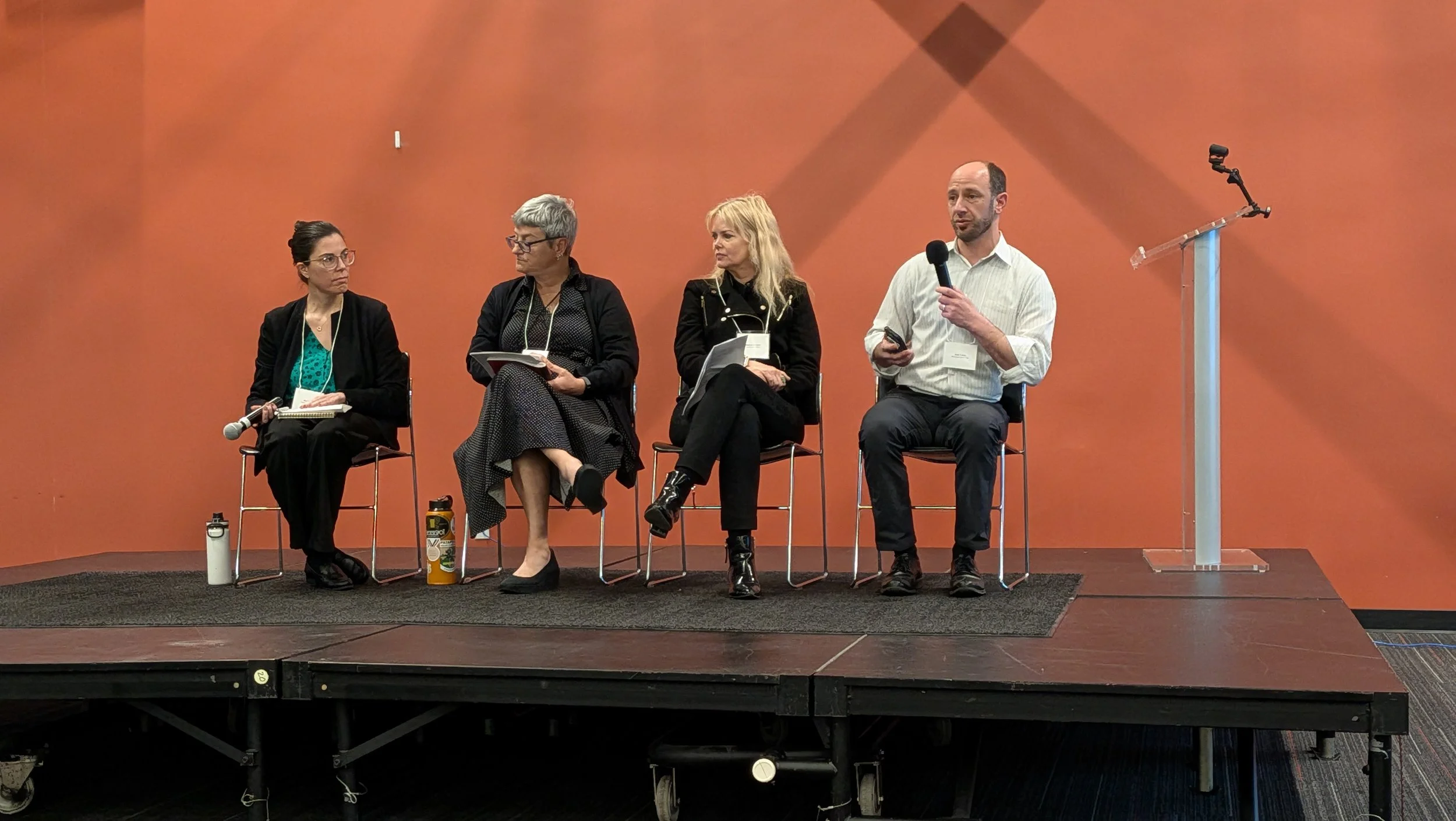
Moderator Josh Tulkin (Sierra Club, right) leads the Climate Finance & Funding Implementation panel with Meghan Conklin (Governor's Office), Jenn Aiosa (MEA), and Kim Pezza (Comptroller's Office, left).
The Climate Solutions Now Act was passed in 2022 establishing statewide greenhouse gas emissions goals, and Maryland’s Climate Pollution Reduction Plan was published in 2023 with a plan for how to get there. A lot has happened since then that directly impacts the state’s ability to achieve what we set out to do through this law.
The plan's pathway to reduce greenhouse gas emissions by 60% by 2031 relied, in no small part, on federal funding that had been appropriated by Congress. Between 2021 and 2024, Maryland secured approximately $13 billion in federal climate funding — a major foundation for state programs across clean energy, transportation, and environmental justice. As of this spring, a substantial portion of that funding has been rescinded, placed under litigation, or put at risk by federal policy reversals. As just one example, $62 million allocated to Maryland through the Solar for All program was rescinded, denying us the opportunity to bring solar benefits to more than 10,000 low-income and disadvantaged households across the state and avoid more than 100,000 short tons of CO2 emissions over five years. Meghan Conklin, Chief Sustainability Officer in the Governor's Office, described the state as actively "backstopping" some of those federal commitments with state dollars.
The plan also outlined potential new state-level funding mechanisms it identified as potentially necessary to support full implementation — including cap-and-invest — but characterized these as options requiring further policy consideration rather than committed revenue. Those mechanisms have not yet advanced. The Strategic Energy Investment Fund (SEIF), a fund dedicated to climate and clean energy programs that has grown significantly in recent years, was diverted to balance both the FY26 and FY27 budgets. The Comptroller's Office is still developing its methodology to track and categorize what Maryland is actually spending on climate adaptation and mitigation, meaning the state does not yet have a complete accounting of the gap between what is needed and what is funded.
Meanwhile, the grid is changing in ways the plan didn't foresee. As Maryland People’s Counsel David Lapp presented at the forum, PJM — the regional transmission organization (RTO) responsible for grid planning and energy markets across 13 states, including Maryland — is contending with dramatically shifted load forecasts driven by the rapid growth of data centers across the region. That surge in demand is reshaping regional energy planning and driving up costs for Maryland ratepayers.
Maryland sets its own clean energy standards, but it consumes power from this regional grid — which means the pressure data centers in other states are putting on PJM is also pressure on Maryland's ability to meet its standards for renewable energy. The 2025 Subcabinet Report notes that Maryland is not currently meeting its renewable energy goals under the Renewable Portfolio Standard (RPS), as some electricity suppliers are electing to pay alternative compliance payments rather than meet renewable targets. Increased regional demand makes that challenge harder, not easier.
None of this is a story of failure. It is a story of changed conditions, and changed conditions require a more explicit, adaptive, and urgently resourced response than "continue implementing the plan."
Three Things the Forum Made Clear
1. The Energy Affordability Challenge Is Real — and It's Not an Argument Against Electrification
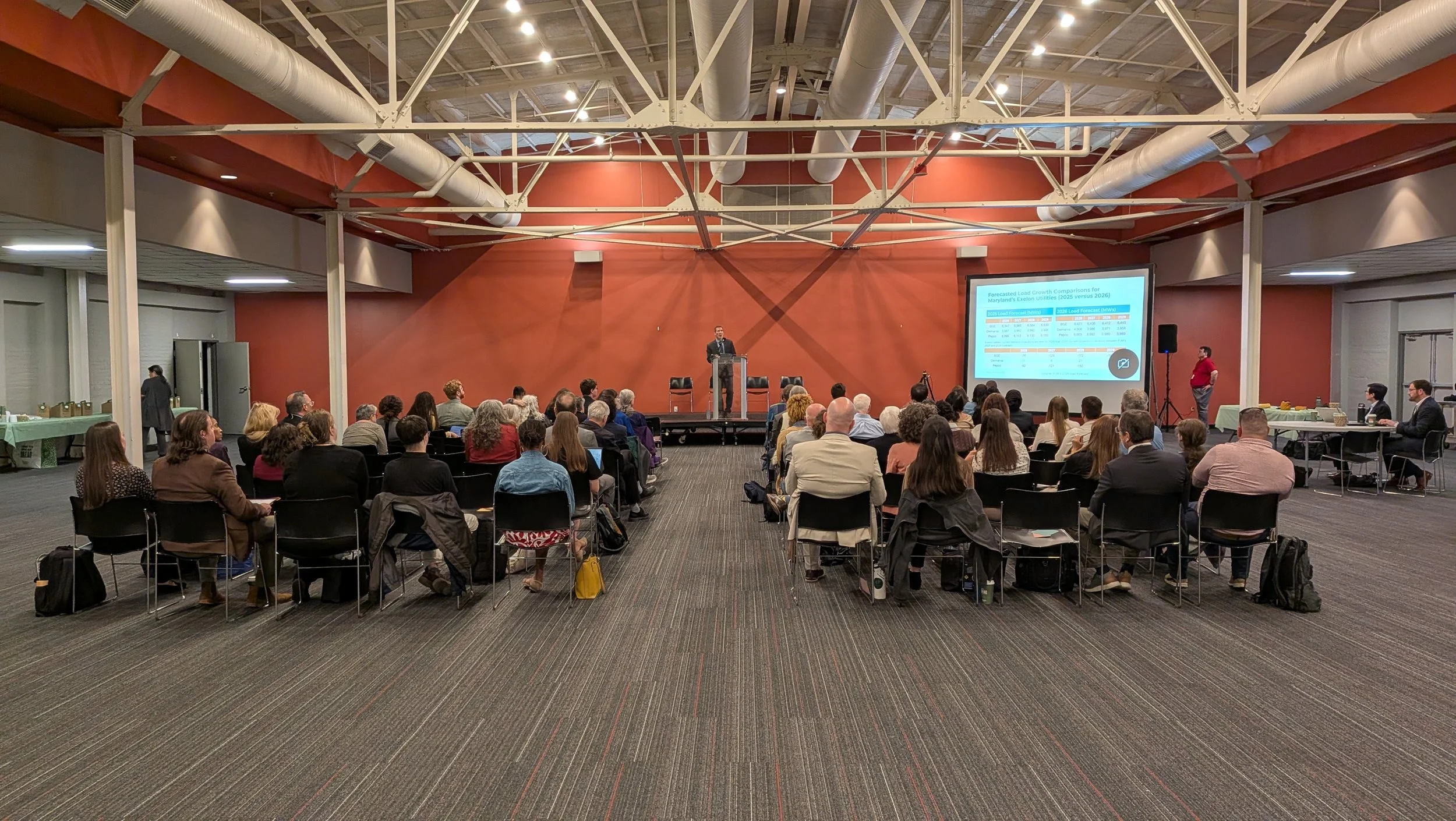
David Lapp (OPC) shares the opening keynote for the forum, addressing energy affordability and grid stability in Maryland.
Walking through rate data from Baltimore Gas and Electric (BGE) and Pepco, Maryland People’s Counsel David Lapp showed that rising utility bills are driven by a combination of distribution costs, transmission charges, and the regional impact of data centers — not by state electrification policy or residential users. For gas rates, distribution costs, from which utilities profit, have outpaced inflation and driven bills higher as utilities look to replace pipelines. This is the jurisdiction of state regulators and lawmakers who can take more action to reduce this spending. For electric customers, state-regulated distribution costs have been more stable; it is regional energy market prices and federally regulated transmission costs that have driven most of the increases. And electrification, the cornerstone of Maryland's buildings and transportation strategy, is a "de minimis" contributor to grid strain compared to the energy demand of data centers.
This distinction matters enormously for climate policy. If Maryland, PJM, and others allow confusion between data center-driven cost increases and electrification costs to take hold — in the legislature, in the media, or in the public — it creates an opening to slow or abandon clean energy goals under the guise of affordability. That would be a serious mistake.
Maryland Climate Partners sees this clearly: the data center problem is real and must be addressed through market and governance reforms at PJM, and by the Maryland Public Service Commission making clear cost allocation to large load customers, so that the costs of demand growth are borne by those driving it rather than passed through to all ratepayers. But the solution is not to retreat from electrification. Clean energy is part of the answer to energy affordability, not the cause of the problem. OPC's support for continued state electrification programs, distributed energy resources (DERs), and alignment of EmPOWER with agency climate goals points in the right direction.
2. Maryland's Climate Funding Base Needs Protection and Expansion — Creative Deployment Is Not Enough

Kim Pezza (Comptroller’s Office) discusses state-level climate finance and funding implementation with fellow panelists Jenn Aiosa (MEA) and Meghan Conklin (Governor’s Office), and moderator Josh Tulkin (Sierra Club).
The finance panel surfaced real creativity. MEA is reorienting its programming around emissions sectors and energy burden. The Comptroller's Office is building a fiscal framework to quantify climate costs to the state. The Governor's Office highlighted programs still moving — EV charging infrastructure, energy efficiency and electrification programs, direct heat pump rebates — while acknowledging that others have been disrupted or eliminated.
Still, creativity with constrained resources is not a substitute for adequate, protected funding. The forum made clear that Maryland's climate funding base faces simultaneous pressure from two directions: federal retreat and state budget diversion. SEIF — the primary vehicle for clean energy grants, funded by Regional Greenhouse Gas Initiative (RGGI) proceeds and RPS Alternative Compliance Payments — has been significantly drawn down in the FY26 and FY27 budget cycles.
Maryland's 2023 Climate Pollution Reduction Plan (CPRP) was direct about what closing the gap would require. The CPRP identified a need for at least $1 billion annually in new funding to achieve the state's 60% reduction goal by 2031 — and outlined a range of potential mechanisms to generate it, including green revenue bonds, a carbon fee, a clean air toll, a pollution fee on fuel-burning vehicles, and cap-and-invest. The plan does not recommend any one approach over another, but is unambiguous that Maryland will fall short of its 2031 goal without additional policy action that both reduces pollution and funds the investments the plan describes. Climate Partners believes cap-and-invest deserves serious consideration as one policy pathway for investing in climate action. It would extend Maryland's existing and successful RGGI framework beyond fossil fuel power plants, require polluters to pay for their pollution, and generate dedicated revenue for clean economy investments. While the Maryland Commission on Climate Change has made a similar recommendation and legislation to study this path has been introduced, the state has not yet moved to advance it.
Maryland also needs to make the affirmative public case for its existing funding streams. SEIF is the financial vehicle for programs that are working, and protecting it requires more than defending it in budget negotiations. It requires telling the story of who benefits and what is at stake if those resources disappear. As MEA's Jenn Aiosa put it, we should lift up the stories of communities that have benefited and make those benefits concrete. She pointed specifically to SEIF-funded grantees in overburdened communities building resiliency hubs — infrastructure investments whose value to a community is real and demonstrable, but rarely visible in the abstract policy debate over funding streams.
3. Environmental Justice Is Moving — But Requires Coordination, Tracking, and Enforcement
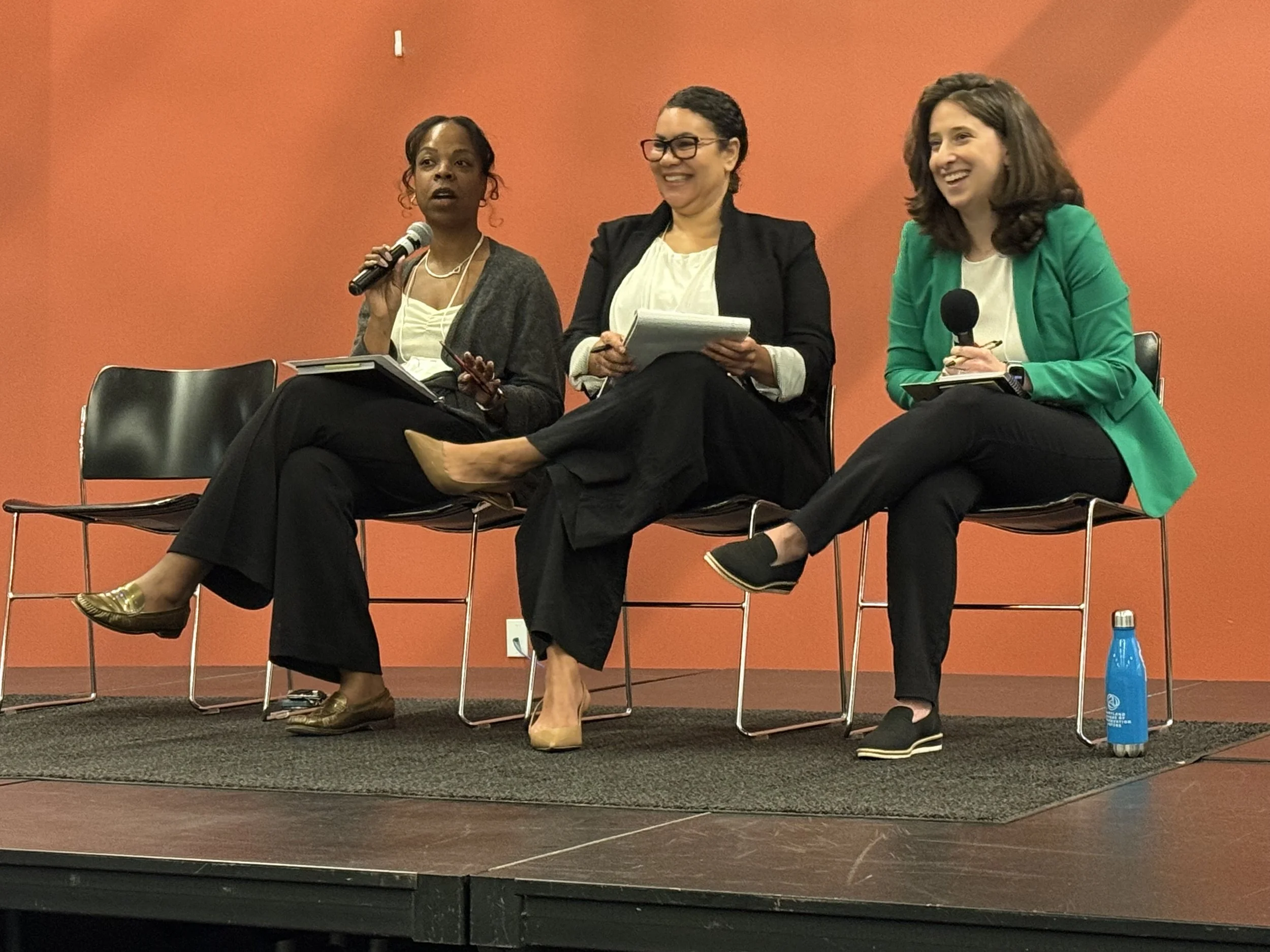
Aneca Atkinson (MDE) and Cat Goughnour (DHCD) discuss environmental justice and equitable climate investments with moderator Rebecca Rehr (Maryland League of Conservation Voters).
The equity panel offered some of the forum's most substantively hopeful content. MDE's Office of Environmental Justice has exceeded its 40% investment target for overburdened communities. DHCD's Just Communities initiative — launched through June 2025 designations — gives approximately 30 programs a mechanism to direct investments toward qualifying communities, grounded in what Cat Goughnour (DHCD) described as a framework of "reparative capital." Both agencies are deploying mapping tools, developing community engagement guidance, and working to understand where benefits are and are not reaching intended recipients. This is meaningful institutional progress, built over several years of sustained effort.
What the forum also made clear is that this work is still largely developing in parallel — across agencies, programs, and commissions that do not yet have strong connective tissue between them. DHCD noted that systems-level work makes tracking impacts difficult. MDE described the ongoing effort to understand the multiple ways its work is relevant to environmental justice outcomes, from preventing pollution to increasing community benefits. Tracking outputs is becoming more sophisticated; demonstrating that benefits are actually reaching the communities that need them most is a harder problem that has not been solved yet. A genuinely whole-of-government approach to environmental justice requires not just that agencies use EJ data in their decision-making, but that EJ considerations are integrated into climate planning, budgeting, and program design across all of state government.
On the regulatory side, MDE confirmed publicly at the forum that under current law, the agency lacks the legal authority to make permitting decisions based on environmental justice data. Permit applicants in high EJ-designation areas must provide notification, and MDE can recommend mitigation measures, but without express legal authority, acting on EJ grounds would leave the agency vulnerable to legal challenge. The Cumulative Harms to Environmental Restoration for Improving our Shared Health (CHERISH) Act would provide that authority, requiring cumulative impacts assessment and meaningful community engagement in major permitting decisions. Notably, MDE has testified in support of the bill, and yet the legislation has now failed to pass for two consecutive sessions.
Federal rollbacks are adding friction to all of this. Both MDE and DHCD described navigating a federal environment that has pulled funding mid-stream and reversed Justice40 commitments that had shaped how agencies were building their programs and tracking their investments. Agencies are adapting, but the disruption is real.
What Climate Partners will be watching for: The question for Maryland's EJ work going forward is whether we can build a government infrastructure that supports community health and addresses cumulative burdens. That means building stronger coordination across agencies and climate planning efforts, advancing the CHERISH Act to give agencies the regulatory tools their current commitment deserves, and fully implementing the Valuing Opportunity, Inclusion, and Community Equity (VOICE) Executive Order as a whole-of-government directive. Climate Partners will be tracking progress on all three.
Managing Is Not the Same as On Track
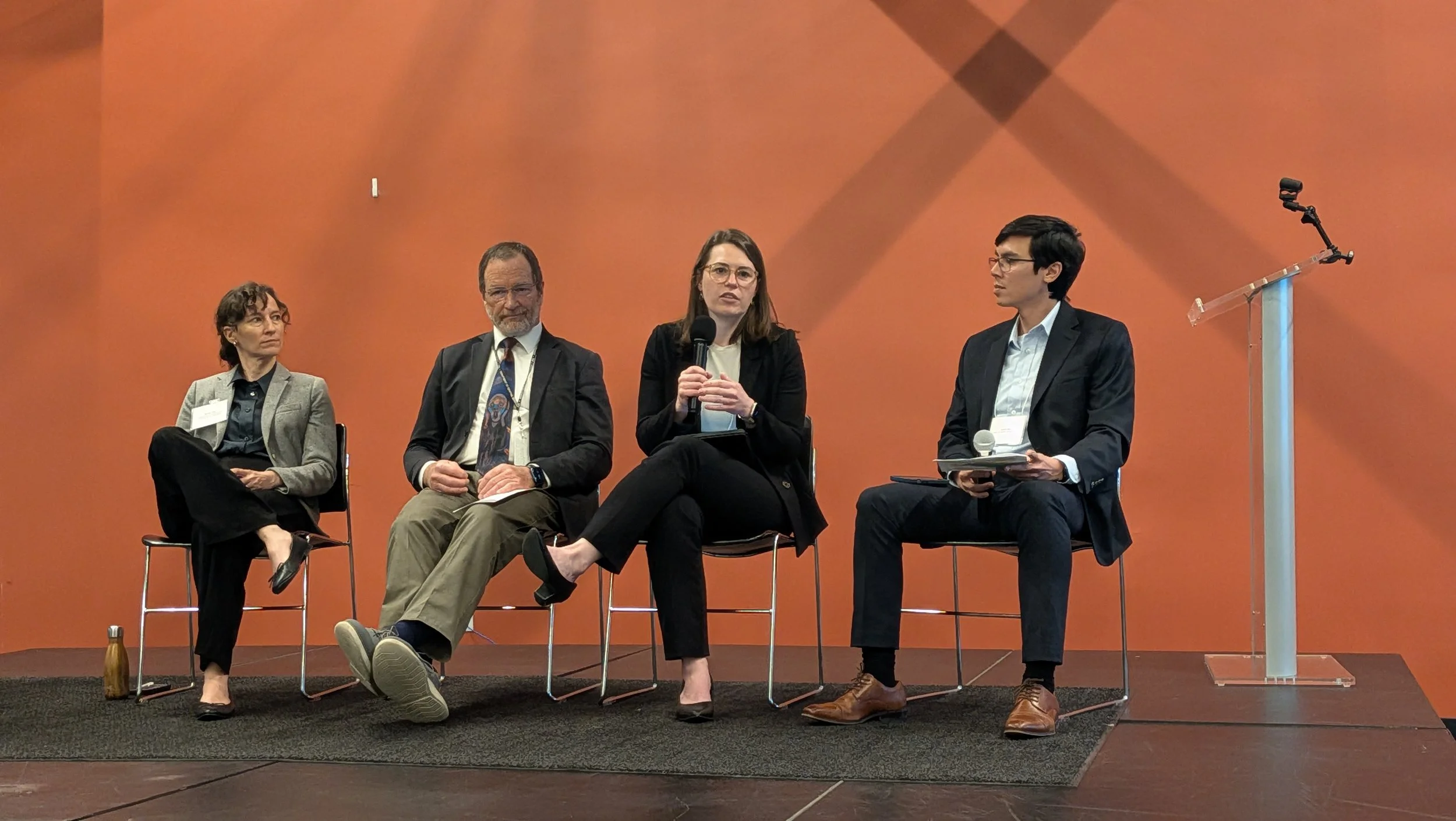
Rachel Lamb (MDE, center) discusses buildings and electrification with fellow panelists Nicola Tran (DHCD, far left) and David St. Jean (DGS, second from left), and moderator Justin Barry (Green & Healthy Homes Initiative, far right).
Maryland agencies showed up to the Spring Forum in good faith. They described real programs, real progress, and real constraints with a candor the coalition appreciated. Climate Partners is grateful for the agencies’ collaboration.
The forum also surfaced a harder question that the coalition believes must be answered honestly. Maryland's own 2025 Subcabinet Report states that statewide greenhouse gas emissions have been reduced approximately 29% from the 2006 baseline. The CSNA requires 60% by 2031. With five years remaining, we are less than halfway to our target. Current policies — even fully implemented — are projected to reach 51%. Meeting the full 60% goal is only achievable with policies that are still in development, still pending legislative action, or still dependent on funding streams that are under pressure.
"Managing" the situation — adapting to federal retreat, finding creative uses for constrained resources, making incremental progress on implementation — is not the same as being on track to meet our commitments. The coalition's role is to hold that standard publicly and to support the policy actions that can close the gap.
What Climate Partners Is Watching — and What We're Asking For
The Spring Forum reinforced and sharpened the three policy priorities Maryland Climate Partners identified at the start of 2026. Here is what we will be focused on in the months ahead.
Protect and expand climate funding streams. SEIF is under pressure, federal funding is not returning on the timeline Maryland planned for, and the state does not yet have a complete accounting of the gap between what is needed and what is funded. Protecting existing funding streams requires making the public case for their value, and Maryland must also seriously explore additional revenue mechanisms to close the gap. The Maryland Commission on Climate Change has recommended that the Moore Administration evaluate and propose potential designs for an economy-wide cap-and-invest program, a next step Climate Partners supports. The Responding to Emergency Needs from Extreme Weather (RENEW) Act cost study represents a similar spirit of inquiry — directing the Comptroller's Office to calculate the financial harm of climate change to Maryland, including potential damages from fossil fuel companies, as a foundation for understanding how additional climate revenue could be generated.
Deliver durable policy signals for building decarbonization. The barriers to decarbonizing Maryland's building sector are not technical — they are financial and political. When the financial case is made clearly, those barriers become surmountable: DGS's lifecycle cost analysis of its 14-year decarbonization plan found that full electrification of the state building portfolio — 17.5 million square feet across 28 large-scale buildings — would reduce energy use intensity by 50%. Policy certainty is what allows the market to invest in the transition with confidence, and that certainty is still missing. The Clean Heat Standard and Zero-Emission Heating Equipment Standard are still in development; the market cannot invest in the transition without knowing the rules. Finalizing these standards, advancing all-electric building codes, and continuing to scale heat pump deployment are conditions for the buildings sector delivering on its share of the 60% goal.
Build the coordination and accountability infrastructure that EJ commitments require. Maryland has programs, offices, data tools, and stated commitments on environmental justice. What it is still building is the connective tissue — between agencies, between EJ and climate planning bodies, and between outputs and demonstrable outcomes in communities. Climate Partners will be watching for progress on cross-agency coordination, full implementation of the VOICE Executive Order as a whole-of-government directive, and advancement of the CHERISH Act to give agencies the regulatory authority their current commitment deserves.
Ensure the clean energy transition isn't slowed by grid planning failures. Data center demand growth is a real and urgent grid planning challenge. The answer is updated cost causation principles at PJM — so that those driving demand growth bear its costs — and continued investment in distributed energy resources that advance Maryland's clean energy goals outside the constraints of the regional grid. Electrification is part of the solution to energy affordability. Maryland's policy posture should reflect that clearly.
Stay Engaged
The Spring Forum was one moment in an ongoing effort. Maryland Climate Partners will continue this work — including through a planned webinar series on agency-specific topics later in 2026 — and will publish additional resources in support of our policy priorities.
Two ways to stay connected:
Sign up for our mailing list to receive updates, resources, and invitations to future events.
Join the coalition — if your organization is committed to advancing equitable climate action in Maryland, we want you at the table.