
What We Heard: Takeaways from the Climate Progress Spring Forum
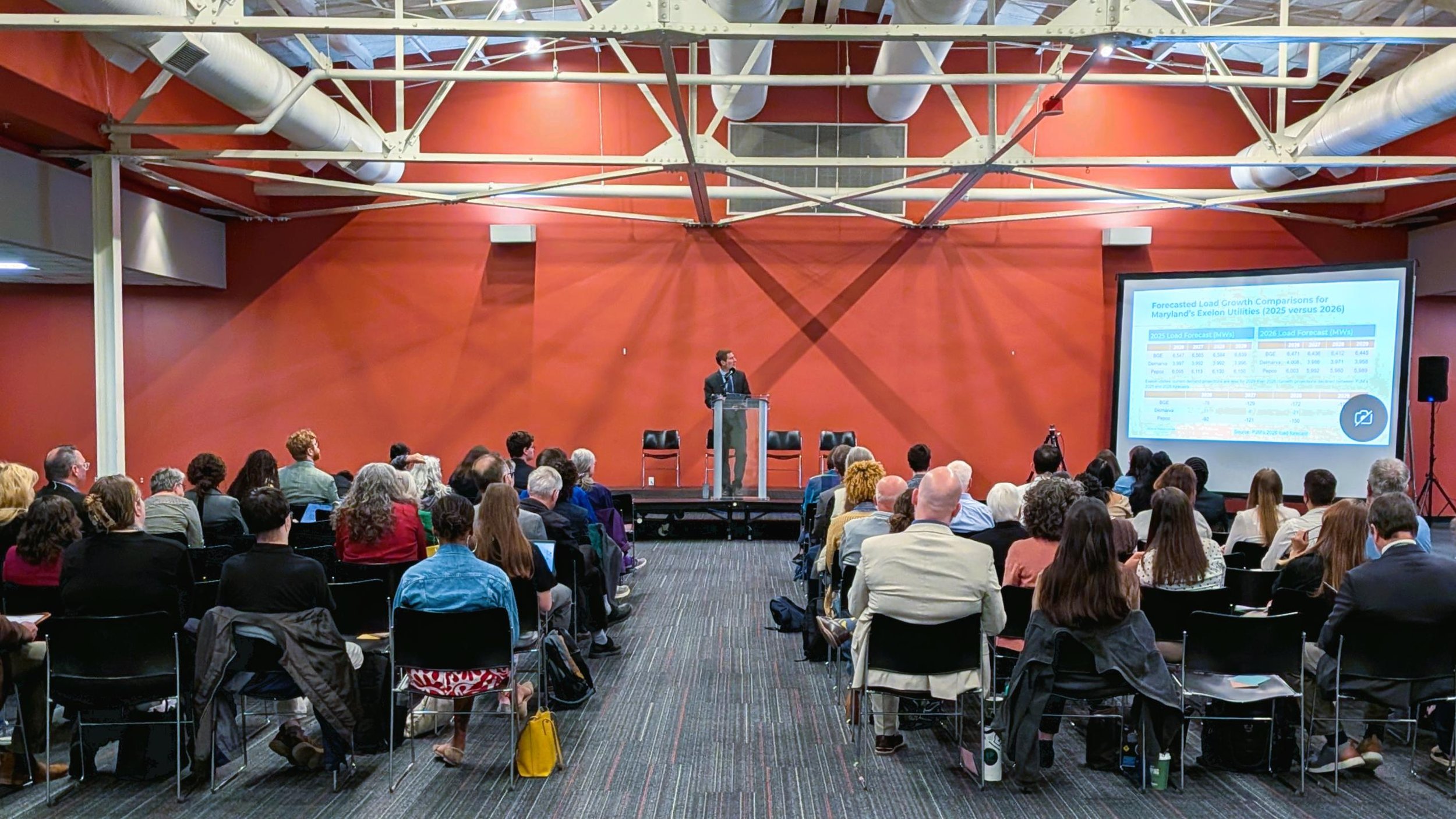
On April 27, 2026, Maryland Climate Partners convened state agency representatives, advocates, funders, and community stakeholders for the Maryland Agencies Climate Progress Spring Forum — a half-day hybrid event focused on cross-sector dialogue and partnership alignment around Maryland's climate implementation efforts. Following the December 2025 Governor’s Subcabinet on Climate Report and our Winter Webinar's agency progress updates, the Spring Forum marked the second installment in a two-part arc, shifting from reporting to deliberating on implementation challenges and opportunities.
Watch the forum recording here:
Below are high-level takeaways from each session.
Keynote: Energy Affordability & Grid Stability
David Lapp, Maryland Office of People's Counsel (OPC)
David Lapp opened the forum with a close look at what's actually driving Maryland energy bills, as well as why the picture is more complicated than most consumers see. Drawing on rate data from BGE and Pepco, he walked through the distinct cost drivers behind residential gas and electric bills, from commodity prices and distribution charges to transmission and capacity costs. His central message: understanding which costs are rising, who controls them, and who bears the risk is essential to making sound energy policy.
Review the slides presented by David Lapp here.
Rising distribution costs—not commodity prices—are the primary driver of increasing utility bills, and unlike commodity costs, distribution spending is a direct source of utility profit.
The surge in large load aggregators (LLAs)—such as data centers concentrated in Virginia and Ohio—is reshaping regional grid planning through PJM Interconnection and raising costs for Maryland ratepayers, even though Maryland is not the source of this demand growth.
Electrification is not a meaningful contributor to grid strain compared to LLA demand and carries co-benefits for health and safety. OPC supports continued state investment in electrification programs.
Distributed energy resources (DERs) offer Maryland a path to advance its clean energy goals outside the constraints of the PJM regional grid framework.
Panel 1: Equity & Community Investment
Aneca Atkinson, Maryland Department of the Environment (MDE); Cat Goughnour, Department of Housing and Community Development (DHCD)
Representatives from MDE's Office of Environmental Justice and DHCD's Just Communities initiative discussed how Maryland is using data and community engagement to direct climate and environmental justice investments where they're needed most, as well as the headwinds they're navigating in doing so.
Both agencies are deploying mapping tools and statutory definitions of "overburdened and underserved communities" to target investments and track whether benefits are reaching intended recipients. MDE has exceeded its 40% investment target for these communities.
DHCD's Just Communities initiative, launched through June 2025 designations, gives approximately 30 programs a mechanism to award bonus points for qualifying communities, with the goal of repairing historic disinvestment through what one panelist called "reparative capital."
Meaningful community engagement is a priority, going beyond basic outreach. MDE has developed applicant guidance on community engagement currently out for public comment, and DHCD is building methodology to document racially exclusionary historical practices.
Federal policy rollbacks pose the most significant current obstacle, undermining trust with communities that had begun engaging with government programs and, in some cases, pulling funding mid-stream from organizations that had stepped up to participate.
Panel 2: Climate Finance & Funding Implementation
Meghan Conklin, Governor's Office; Jenn Aiosa, Maryland Energy Administration (MEA); Kim Pezza, Comptroller's Office
Representatives from the Governor's Office, MEA, and the Comptroller's Office examined Maryland's climate funding landscape at a moment of significant federal uncertainty by taking stock of what's at risk, what's still moving, and how the state is working creatively with the resources it has.
Maryland secured approximately $13 billion in federal climate funding between 2021 and 2024, but a substantial portion is now rescinded, under litigation, or at risk—including $62 million for the Solar for All program—requiring the state to backstop some federal commitments with state dollars.
The Strategic Energy Investment Fund (SEIF), fueled by the Regional Greenhouse Gas Initiative (RGGI) and Alternative Compliance Payments (ACPs) from the Renewable Portfolio Standard (RPS), remains a key vehicle for clean energy programs, though FY27 budget pressures have drawn down the fund significantly. Panelists emphasized the importance of protecting and communicating the value of these funding streams.
The Comptroller's Office has developed a climate fiscal management program and, through the newly begun Maryland’s Cost of Climate Change Study, is working to quantify the full cost of climate-related spending to the state, including adaptation, extreme weather response, and potential fossil fuel liability pass-through to taxpayers.
With funding constrained, agencies are prioritizing creative deployment: MEA is reorienting programs around emissions sectors and energy burden, while all three panelists pointed to storytelling— lifting up real community beneficiaries—as essential to defending climate funding politically.
Panel 3: Buildings & Electrification
Rachel Lamb, MDE; David St. Jean, Department of General Services (DGS); Nicola Tran, DHCD
Representatives from MDE, DGS, and DHCD discussed the state of building decarbonization in Maryland: where programs are gaining traction, where the bottlenecks are, and what policy and market signals are needed to sustain momentum toward the state's climate goals.
Maryland's Building Energy Performance Standards (BEPS), tied to the Climate Solutions Now Act (CSNA), now cover approximately 9,000 buildings statewide—roughly 65% have begun benchmarking, and around 30% have already met performance targets, though panelists noted continued legislative evolution, including hospital exemptions.
DGS has launched a planning process covering 17.5 million square feet of state-owned buildings, targeting all-electric new construction and fossil fuel phase-out across existing facilities; their 14-year decarbonization plan projects a 50% reduction in energy use intensity (EUI) at an estimated cost of $133 million—compared to approximately $120 million in BEPS compliance penalties if the state does nothing.
Affordability and contractor capacity remain the primary barriers to broader electrification uptake: utility costs, misconceptions about heat pump performance, and a limited pool of trained contractors all slow adoption, particularly in low- and moderate-income (LMI) and multifamily housing contexts.
Panelists agreed that durable policies—including the Clean Heat Standards (CHS) and Zero-Emission Heating Equipment Standards (ZEHES)—are essential to giving the market the certainty it needs to invest. All three closed by calling on stakeholders to engage actively in ongoing public comment processes and to share the stories of early adopters.
Interactive Discussion
The forum closed with a structured facilitated discussion, inviting participants to reflect individually, then discuss their ideas with a partner, and finally synthesizing takeaways in small groups. Several consistent themes emerged during the conversations among our participants:
Electrification and energy efficiency were frequently cited priorities for Maryland climate action in 2026, with participants noting that weatherization, stronger building standards, and clean heat programs are mutually reinforcing. Energy affordability and that affordability is the linchpin.
Contractor training and public education came up repeatedly as conditions for progress—particularly around heat pumps, where knowledge gaps among both homeowners and installers continue to slow adoption.
A recurring tension: financing exists, but it isn't always reaching the people and projects that need it most. Participants pointed to the need for trusted messengers, streamlined access, and strategic outreach to connect eligible households and organizations with available programs.
Participants identified cross-agency coordination and coalition collaboration as underutilized assets, with the room itself—spanning state agencies, advocates, community organizations, and academic institutions—seen as evidence of what becomes possible when these sectors work together.